

Writing Poirot

Updated: 3 hours ago

I am taking a break from writing our next Poirot-themed Murder Mystery - Poirot Investigates: What Shall We Do with the Murdered Sailor? - so thought it was the perfect time for a Poirot-inspired blog post!
Yes, we do a lot of Poirot, amongst other Agatha-Christie inspired murder mysteries; in fact we have such a reputation for 'doing' Agatha Christie that the British Library have asked us to host an Agatha Christie-inspired murder mystery as part of their Agatha Christie Exhibition (more info about that to follow!).
So how does one 'write Poirot'? It is daunting, bearing in mind what a much-loved institution the little Belgian detective Hercule Poirot is. What if I get it wrong? I am sure Agatha Christie had a very specific picture in her head when he first appeared in The Mysterious Affair at Styles (written in 1916 and published in 1920). Christie describes Poirot as 'a little man' with an 'egg shaped head' and 'stiff military moustaches'. His appearance is meticulous, his dress a little flamboyant.
However, contemporary interpretations of the character have varied - David Suchet, who appeared in the BBC television series Agatha Christie's Poirot (1989–2013) is 5'7" tall, whereas John Malkovich who appeared in The ABC Murders in 2018, is over 6 feet tall. Whilst Malkovich and Suchet both have significantly receding hairlines (thus fitting the 'head like an egg') description, Kenneth Branagh, who played the Belgian detective in three Poirot movies from 2017 to 2023, has a generous head of blonde hair.
Left to right, David Suchet, John Malkovich and Kenneth Branagh, all as Poirot in various television and film adaptations
We can accept, then, that appearances may vary. I think it is fair to say that the key to manifesting an authentic Poirot (and by this, I mean a Poirot Agatha Christie would recognise and hopefully approve of) is staying true to his character - his flamboyance in dress, his fastidiousness, vanity, gentle humaneness, his need for order, his constant reference to his 'little grey cells'.

A question: when recreating Poirot in the 21st century, should one take a 21st-century interpretation? Poirot's desire for order, symmetry and neatness and his attention to and unique perception of fine details suggest what we might nowadays call autistic traits; his flamboyance, concern for tailoring, his unmarried status (in contrast to his friend Captain Hasting's continual romantic endeavours with women) suggest, in a 21st-century reading, sexual ambiguity.
Personally, I think it is a mistake to follow this thought process too far. Poirot was conceived in the early 20th century and belongs firmly in the early 20th century. In fact, I would argue that a successful creation of Poirot's world actually involves a recreation - we need to hark back to the bygone era of bobbies on bicycles and first (yes, there is no shying away from a slightly colonialist world-view at times) forays into frightening foreign lands.
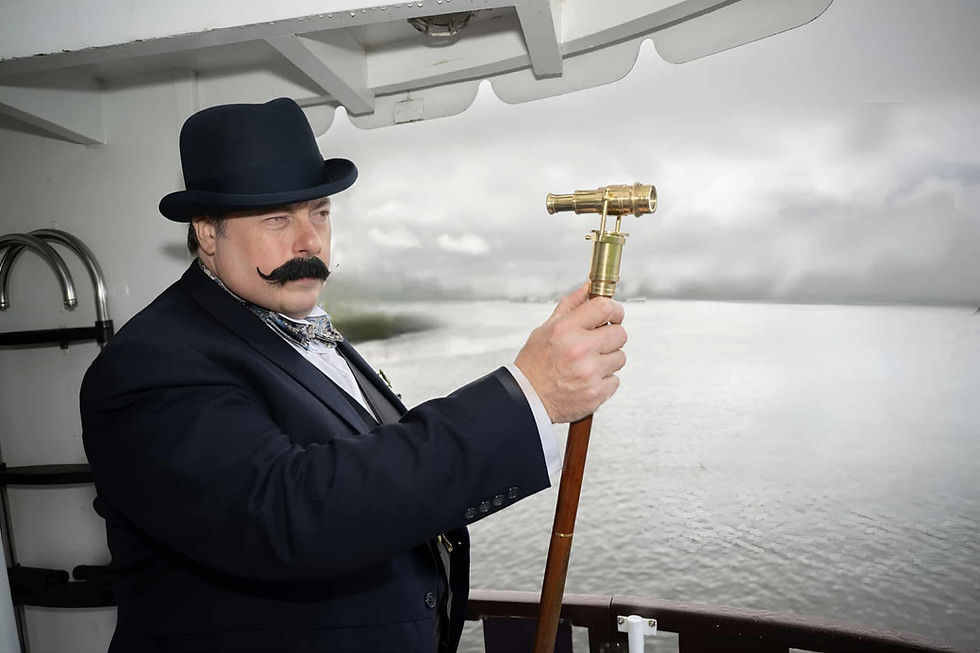
It is nostalgia people keep returning to Agatha Christie's Poirot for - and I suspect this may have been the case even in Christie's time - note the name 'Hastings', which subtly evokes a glorious English heritage and tradition.
Like the oblique reference to 'Englishness' in Hastings' name (I mean, of course, the Battle of Hastings), names and places are extremely important in Poirot stories. What are good names for a Poirot story? What is a good setting - the Nile? Egypt? A train? The English countryside? A boat...?
Now we have come full circle. I am writing a story for Poirot set on a boat. On the Norfolk Broads. Or should it be America - it is the Southern Comfort Mississippi Riverboat, after all! Should Poirot be chasing spies or fending off crocodiles?
We shall see... If you do have a ticket and are able to come along, do let me know how successful you thought I was...
Dreamstone Productions is a Murder Mystery and Comedy Dining Events Production Company based in Norfolk UK.
Donna K. Triggs is an actress, producer, writer and director. Read more about her at www.donnaktriggs.comand www.laurelandhardyplay.co.uk


Comments